Showing posts with label visual literacy. Show all posts

24 April 2016

Visual Literacy in Mathematics

Have you ever seen mathematical images like this?
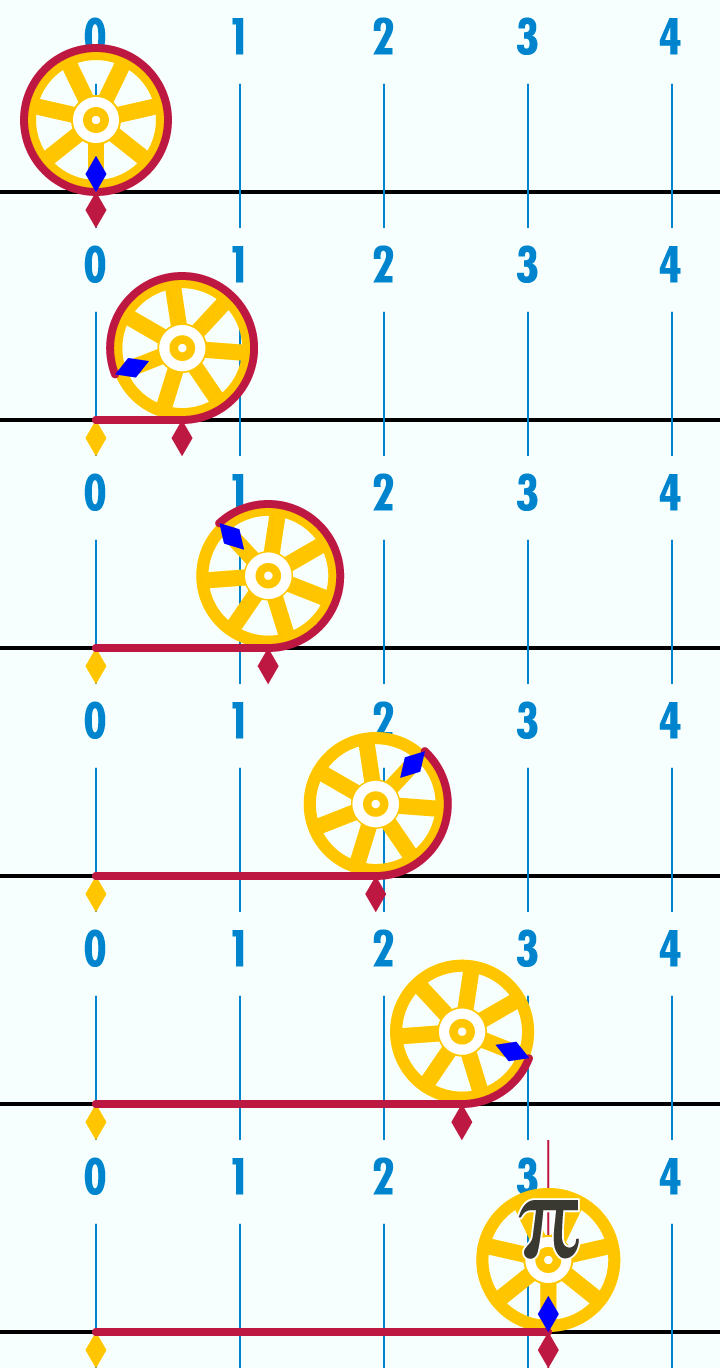

This image gives a visual explanation as to why pi is 3.14 -  you see how the circumference of the circle is 3.14 time the radius.  It's very clear.  Where were educational images like this when I was growing up?


Matthew Peterson discusses the idea of teaching mathematics without words in his Ted Talk (below).  He does a very good job of showing (visually) how much teachers rely on words for teaching.  Growing up with dyslexia, words gave him nothing but problems, and then he read about Albert Einsteins struggle with dyslexia.  Albert said this:


Wow ... one of the greatest mathematical minds of all time talks about the importance of visual literacy in his own understanding.  That's really powerful, especially to learners who do struggle with words.  


As a visual learner myself, I have long been interested in how to teach mathematics visually in order to build conceptual understanding. At my school we use the Singapore Math pedagogy to teach mathematics K-8.  Central to this model is the Concrete - Pictorial - Abstract approach, which is really the opposite of traditional math education.  In Singapore Math we start out by making math concrete, with manipulatives, examples, puzzles, real-world problems.   Then we introduce the pictorial approach by using pictures, images, and models.  The last step (as opposed to the first) is to introduce the abstract - the computation, the algorithms, etc.  
http://kateshomeschoolmath.com/singapore-math-buying-guide/

So this is my final project for this course on Visual Literacy.  This is how I made learning how to balance algebraic equations visual.  I found a great website with visual puzzles that really reinforce the concept of balance, which is the central concept of this unit.  Students start out visualizing the balance of the mobiles by doing math in their heads.  After they have done a few puzzles, then I ask them to connect what they are doing visually to what they have already learned about algebraic expressions, by writing an equation.  Then, by reflecting on the math they were doing in their heads, they can articulate how they are using inverse operations to solve the equations.  See my lesson below and the accompanying video underneath it. I would love to connect with any other mathematics teachers who are also working on using visual mathematics to teach.


albert einstein image from Michael Wohlwent at the Noun Project

Slow Looking

As part of my learning in this course this video talk by Brian Kennedy stood out to me:


He introduces this method for slow looking @8:52.

As a science teacher I'm constantly asking my students to make observations.  Often, I find that they look, see and sometimes describe, but rarely get past that point on their own.  This is a nice natural progression to encourage students to observe the world around them more carefully, and to analyze it and make meaning from it, to better understand the world around them.   It would make a nice poster on the wall to remind and encourage students to go further.

This carries over into mathematics as well.  Often times it takes much more than looking, seeing and describing in order to solve complex and challenging math problems.  But when students can create visual representation of problems, using models and such, then they can see and describe AND analyze and interpret. 


Visual Literacy

The next course is one on visual literacy.  I've always felt like I had a lot of experience in this area since I, myself, am a visual learner.  I am no artist, but I have spent many years doing digital scrapbooking for my family.  This meant that I learned to use photoshop, I learned about design, and most importantly, I learned how to use design and visual cues to communicate a message.


Awww... my kids were so young back then!!  It's fun to go back and look at those old photos!  

Applying the principles of design to my teaching is not at all a stretch.  I find that I use my skills quite often when designing presentations, making worksheets, organizing meetings, and even planning after school activities.  But it wasn't until recently that I made the connection that 


That was a profound learning for me.  And my own own visual literacy skills turned more into modeling rather than using them for practical purposes.  The intentionality of teaching students to use resources like Canva, the Noun Project, Google Slides, iMovie, Piktochart, PicMonkey and so many more, is now woven into my lessons throughout the year.  Whether the students are taking notes, making a movie, creating a presentation or working on any project, there is always an opportunity for them to connect their verbal understanding to something visual.